The following feature appears in the March 2026 issue of Mile High Sports Magazine, which is available now. To see the full digital issue, click here.
Hugs welcome everyone that joins Brooklyn Gilhooly for lunch.
Seated toward the end of an extra-long pub table, Brooklyn is wearing a black, long-sleeve Nike workout shirt. She nibbles on a hamburger as she holds court in the sprawling ‘Table at Regis’ dining facility at Regis University.
Between hugs and conversation, she dips her burger with a swirl into ketchup that’s been pumped onto a small white plate and takes another bite.
First up is Elizabeth, her friend who wears a tie-dye tee shirt from the 1990s era ska punk band Sublime. Later, Megan arrives for lunch. She has a white Hello Kitty fanny pack stretched across her chest. From it, she pulls a necklace with a half-heart, a gift from Brooklyn — who has the other half.
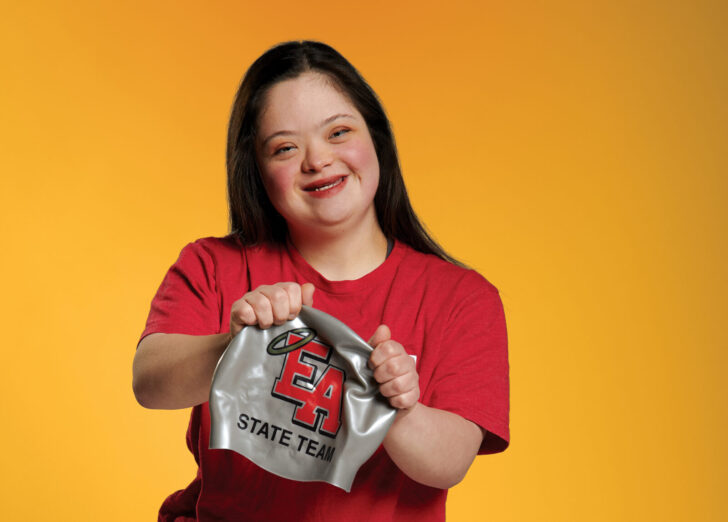
Seated across from Brooklyn is her father, Tommy Gilhooly, the Associate VP/Director of Athletics & Strategic Partnership at Regis. Brooklyn, 20, is in her first year at Regis and studying for the GLOBAL Inclusive College Certificate Program.
The GLOBAL program provides a collegiate experience for 24 young people with intellectual disabilities. Brooklyn, a college student with Down syndrome, lives on the Regis campus in a suite with four other members of the GLOBAL program.
Just like any other student on campus, she visits the Regis Fitness Center five days a week. She strolls to Loyall Hall for class and hangs out at the Ranger Den, where there’s karaoke, a patio lined with Adirondack chairs and other fun activities to fill students’ free time.
A part of the Rangers Unified team, Brooklyn plays on the flag football, basketball and soccer teams. Other students in the GLOBAL program fill the table, and the conversations are probably similar to the ones taking place at other nearby tables. Members of the men’s and women’s basketball teams file in and make up small talk with Tommy and other GLOBAL students.
When asked what she likes about basketball, Brooklyn doesn’t hesitate – she’s all about offense.
“I like to practice dribbling and shooting,” Brooklyn said. “And scoring. We got second place at regionals.”
With a father’s charm, Tommy chimes in with her nickname and gets the entire table involved.
“How about defense, BK?”
Suddenly the entire table comes alive. With a laugh and smile, catcalls from the peanut gallery fill the air as some of her teammates get in on giving Brooklyn some good-natured ribbing.
“Defense!”
“Oh, yeah Brooklyn, how about defense?”
A giant smile plastered across her face, Brooklyn laughs, raises her hands to her eyes and sheepishly says, “Yeah, defense.”
There’s a camaraderie that’s palpable. As ambient light pours into the softly-lit, wide-open, wood-trimmed space, the chatter from the GLOBAL students creates a welcoming vibe. The students here aren’t just part of an inclusion program. They are thriving, and living their best college lives.
The Visionaries
Dreams are what Jermaine Stafford spends his days making sure come true.
As the Facilities Director for UPSWING Centennial, Stafford is focused on sports performance training, dance and recovery for athletes 19-years old and younger. UPSWING has also worked with the homeless youth community in Denver. On Friday nights a faith-based initiative dubbed “Friday Night Lights” reaches another population segment.
But when a grant led UPSWING to train GLOBAL students twice per week, for two hours per session, from last June through August, the impact it had on athletes and staff was remarkable.
“We all instructed the athletes and had them go through sessions,” Stafford said “It was so refreshing. I can’t even put into words what it was like. I’ve been in performance coaching for 30 years, and it’s not every day you get an opportunity so heartfelt. It served a purpose well beyond finance. It’s easy to train and have services rendered; this was totally different. I felt blessed to be put into a position to pour our energy and efforts into these young people.”
The efforts Michelle Sie Whitten has poured into the GLOBAL Foundation have led to numerous opportunities for the program’s participants. She concurs — everything about the GLOBAL program at Regis, and the work done over the summer at UPSWING, stands out as exceptional.
Yet, Sie Whitten wants more. The President, CEO and co-founder of the Denver-based Global Down syndrome Foundation is the visionary that helped establish what is in place. She founded GLOBAL in 2009, when
her daughter Sophia was born with Down syndrome, and is proud of its growth, but she also sees how it can be improved, tweaked and scaled to reach an even larger audience.
Regis is the only Jesuit university and the second Catholic one with a post-secondary program for students with intellectual disabilities. There’s untapped potential for the program to grow and spread across the country. However, even as it seems like GLOBAL has a solid template in place to scale the program, Sie Whitten wants to capture more data, because she said the field of “how people learn with intellectual disabilities is a desert.”
The first class, in which her daughter is enrolled, is set to advance this spring.
“We are only scratching the surface here,” Sie Whitten said. “We were told [to] never get funding or never launch a program and get medical funding. Fast-forward to today: we are the largest pediatric Down syndrome center in the United States. With 2,700 patients, we are the second largest in the world.
“We think pretty big. Our vision is codified in our agreement with Regis, and we provided the seed funding for this. We actually co-created the curriculum and everything about it. We brought the expertise. So many programs are one or two years. Our students go four years, and that was very important to us.”
While Creighton, Gonzaga and Loyola Marymount are other universities that have expressed interest in the GLOBAL program, there’s still work to be done.
“We can’t give away something that’s not fully baked,” she said. “We envision a world where when we help you launch this in your university, we have done our due diligence and built a strong core curriculum that we want everyone to use.”
What everyone at UPSWING used was the inspiration brought forth by the GLOBAL students.
“Kids with Down syndrome can do everything grown up adults can do – everything,” Stafford said. “They are just as equipped to do what we do. They were so excited to show they can train and do the same things we do athletically. There’s no inability for them to grow as people through sport.”
Opportunity
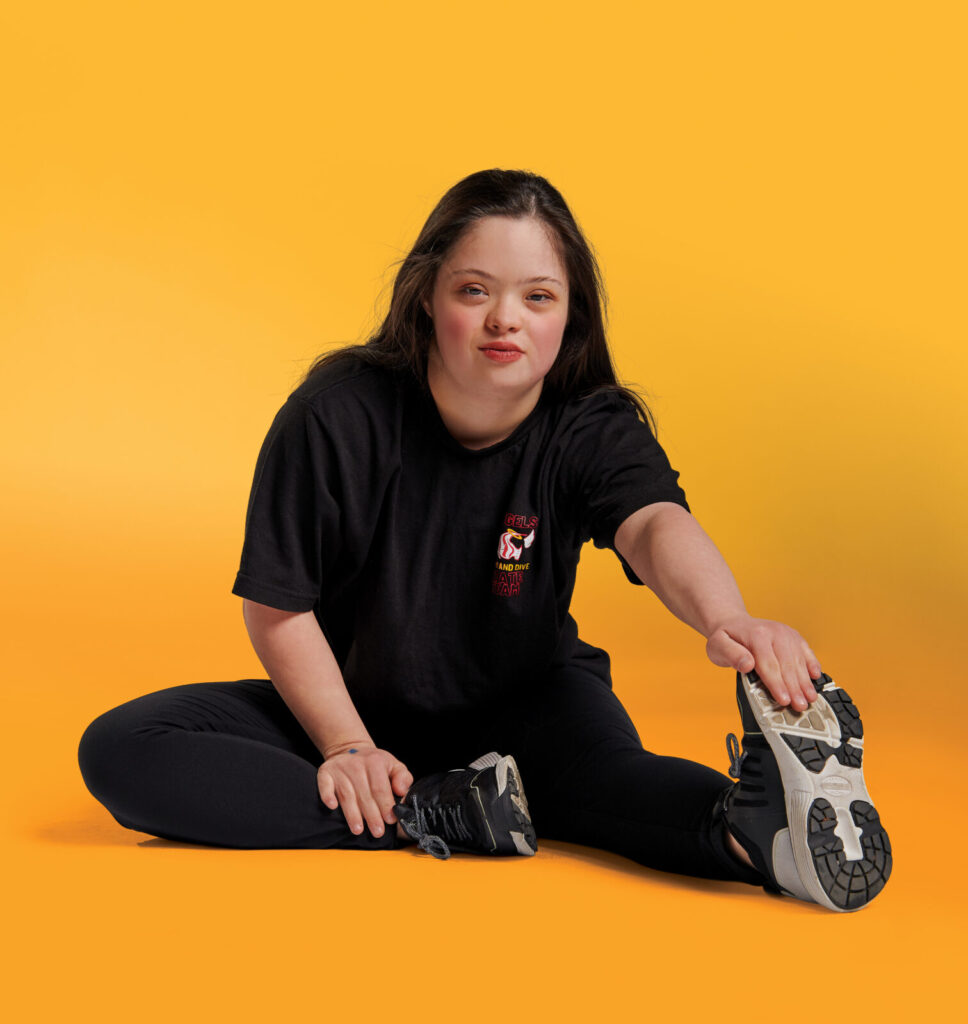
(Randy Parietti Photography)
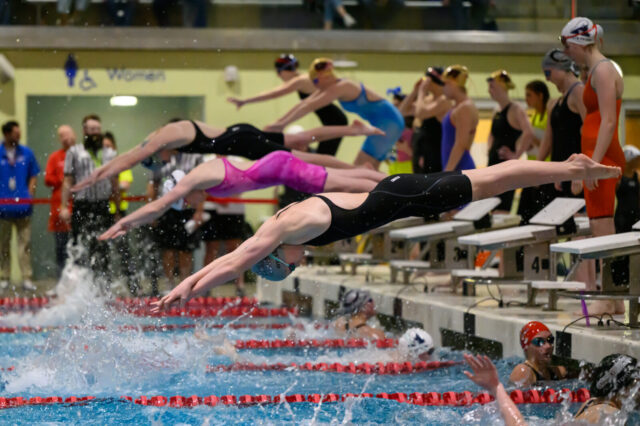
Tommy, Nicole and Brooklyn Gilhooly stood above the pool at the Carla Madison Recreation Center.
As father, mother and daughter watched Denver East swimmers begin their practice routine, they prepared to ask coach Dave Quintana if Brooklyn could be on the team.
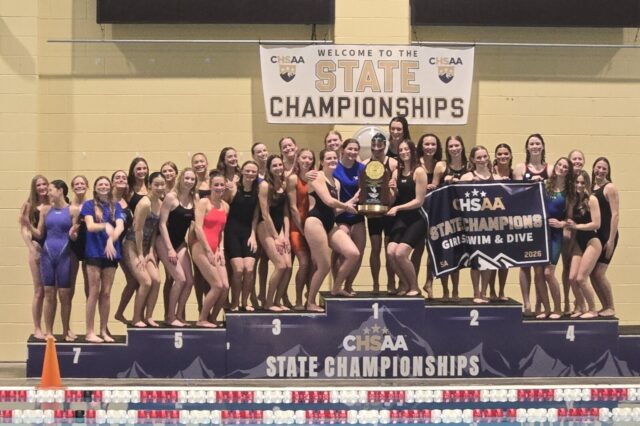
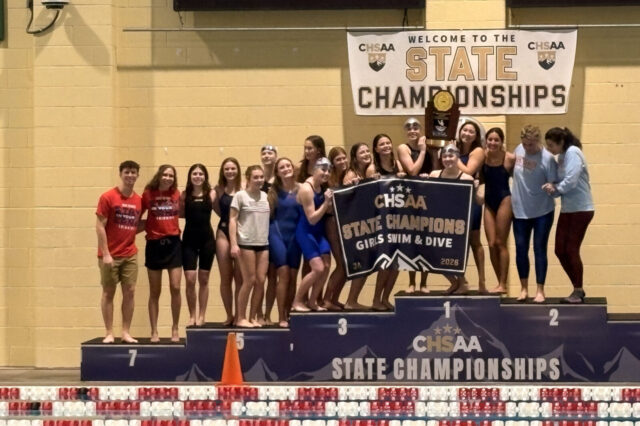
The veteran coach, who has led the Angels to 11 Denver Public School swim league titles in his 18 years at the helm of the program, said he would welcome Brooklyn to the team, but she had to meet the standard of every other athlete.
He had practices to run and a team to coach and she couldn’t be a distraction. It’s an answer that had to be music to Tommy and Nicole’s ears. They raised Brooklyn to never back down, and she embraced the challenge of being a member of the Angels swim team.
“I treated her the same as all the other girls on the team; the whole coaching staff did as well,” Quintana said. “I expected her to do everything the same way everyone else did. She’d get yelled at or have to swim a 50 — just like everyone else would — if she was messing around. I expected her to do the job she was supposed to do.”
Being held to the same standard as her brothers started at an early age for Brooklyn. When the kids were younger, Tommy and Nicole dropped them off for ski lessons. The parents had some down time and hit the slopes for a few hours, with their children supposedly getting instruction.
After a few hours, Tommy returned to find Sean and Jimmy working their turns on the bunny hill. But Brooklyn wasn’t working on wedging or poling. She’d found her way off to the corner of the hill and was making snow angels. Tommy asked the ski instructor why Brooklyn wasn’t engaged with the rest of the class.
“The instructor told me that she was tired,” Tommy said. “I told him I wanted to see her skiing, and it was okay to be tough on her. We wanted her to ski ,and she was going to ski. When we came back, she was skiing. I take that as a life lesson. Many have the ability, but what is the environment — and what is the expectation?
“She’s never been treated any differently than two, very athletic, high-performing brothers. She rises to that expectation. She’s fearless. She’s not afraid of anybody.”
Tommy wasn’t surprised when Brooklyn rose to the occasion as a member of the East swim team. After all, he’s joked with her about being a mermaid, because of the way she took to the water at a young age.
“She swam varsity and beat other kids,” Tommy said. “That’s where she found her happy place. She’s had an incredible journey. She’s always been ahead of the curve in learning things. So the first time she was in the pool with those ladies, I wasn’t worried about her ability to swim or her safety. We had to wonder [that] if her mom or I stepped out, would she wander off? But we learned that wasn’t an issue, and from there, we were never concerned.”
When she was 3 years old, Nicole first took Brooklyn to private swim lessons at a neighborhood house.
The round pool filled most of the back yard, and as part of the deal, Nicole had to pass back through the gate through which she and Brooklyn entered. No parents allowed, just a 1-on-1 lesson where the student and instructor can get down to business.
“She’s always been a great swimmer,” Nicole said. “We put her in swim lessons early on. I think she was maybe 3 years old.
“When we dropped her off, the instructor told us, ‘You guys can leave.’ When we came back, the instructor had us watch what Brooklyn did. She pushed her way under water, swam down and grabbed a little pink pool ring like it was nothing.
“She’s always loved swimming. We are members at a pool in the summer, and when the lifeguards blew the whistle for adult swim, she was always the last to get out of the pool. We had to chase her out.”
Game Time
Tommy called it his game face, and Brooklyn saw right through it.
When Nicole was diagnosed with breast cancer and receiving treatments, Tommy came home from work, determined to keep everyone’s spirits high. He wasn’t eating or sleeping well. He worried for his wife’s wellbeing and had increased responsibilities around household operations. He’d shuffle between home, work and the hospital.
But the moment he hit the family’s front door, he buried the exhaustion and all those feelings deep. He’d grab the boys and start wrestling, telling jokes and laughing. Anything to keep the family immersed in positive vibes.
“I’d come in and say, ‘Dad is home!’” he said. “I’d wrestle with the boys and everyone would have a good time. I’d go to hug Brooklyn and she’d pull away and look at me right in the face. She’d ask, ‘Daddy, are you sick?’”
“She could see it on my face, she would worry and hold my face and say, ‘Daddy is sick.’ It’s just something I couldn’t hide from her. When people are down, there’s just something about it that she can see. She’s so authentic; I couldn’t hide it from her.
“She might not be super eloquent with her linguistics, but she can really be the pied piper.”
College
Team photos hang on the brown-brick walls at the Regis Field House lobby. Regis’ team colors of blue and gold fill the space as the images of collegiate athletes stare down at all who enter.
Pictured just outside the glass doors of the athletic department administrative offices are basketball players in their shorts and jerseys. Baseball players pictured in uniform with their pants, jerseys and hats. Cross country runners in their bibs and runners’ shorts.
It’s typical fare for a collegiate athletics department to proudly display its student athletes. Hanging on the same wall is a photo of the Regis Unified team, right next to every other athlete at Regis. In the left-hand corner of the Unified team picture is Brooklyn. She’s wearing a blue jersey, right arm raised as if she’s flexing. Ready to take on all comers.
That’s the attitude Regis unified coach Abby Weber has grown to love.
“Brooklyn is very spirited,” Weber said. “She wears her heart on her sleeve. She’s very energetic, sassy and confident in who she is, and what she brings to the table. She’s very confident, even though I think coming to college has been a big life change and adaptation for her. She’s living here without her parents during the week. She goes home on the weekend. But she’s responsible and on her own here. Working with her is a new experience every day; she always brings a sense of joy and laughter, whether that’s in the classroom, practice or anything she does.”
Off to Class
Brooklyn is eagerly awaiting the arrival of Nick Hansen, her boyfriend.
He’s into powerlifting and holds a black belt in taekwondo. He strolls in just before Brooklyn has to leave for class. He’swearing a red t-shirt with a large No. 6 on the front and the Tampa Bay Buccaneers logo printed just above the number. It’s a Baker Mayfield “shirzey” – Nick’s favorite player.
“He’s got a YouTube channel,” Brooklyn said. “He kicks hard. He’s got a kick board [that] he kicks when barefoot.”
As a weightlifter, Nick, who has a barrel chest to match any strong man, squatted 205 pounds at the Special Olympics Colorado 2025 Summer Games to set the state record for the junior lightweight division.
When he heads to the counter for lunch, Brooklyn follows. They’ve only got a few minutes to hang out. She has to trek across the quad to go to class: Speaking With Authority.
But she can catch a ride on the back of Tommy’s golf cart, tricked out like a ‘57 Chevy, and make it to
class on time.
When Tommy softly says, “On your left,” to a female college student headed to class, the performer in Brooklyn comes out.
“Slide to the left, slide to the right,” Brooklyn says to the rhythm of Cupid’s seminal hit ,’Cupid Shuffle.’ “That’s the Cupid Song.”
The golf cart comes to a stop at the stairs that lead to Loyal Hall. A giant white cross hangs from the right side of the single-story brick building. Brooklyn hops off the back of the golf cart.
She doesn’t step to the left or step to the right; there are no crisscross moves being made — but with a bounce in her gait, she goes straight up the stairs.
She throws a hand up in the air and with her back to the golf cart, says, “Bye, guys.”